From Microsoft Access to SQLite
With the launch of Trados Studio 2026 Release in July 2026, a new terminology format was introduced: .ttb (Trados Termbase), which is supposed to replace the older .sdltb format. Upon fact-checking this software we safely conclude the following:
- Essentially, it is simply about a conversion from a Microsoft Access database format (.sdltb) to a SQLite database format (.ttb) and nothing more. Both database formats are simply data repositories (holding terminology and a number of XML structures) and as such there is no functionality attached to them.
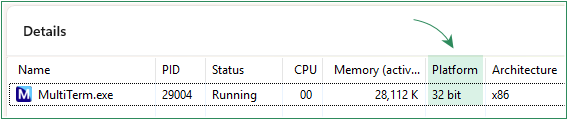
- Even though the newest iteration of Trados Studio 2026 Release is built on a native 64-bit core (which is not actually a breakthrough since 64-bit software officially hit the mainstream PC market in September 2003) MultiTerm 2026 Release continues to be a 32-bit platform application. This can be easily verified in Windows Task Manager.
- The functionality of a Termbase, be it a .ttb file or a .sdltb file depends exclusively of the programming algorithms in either Trados Studio or in the traditional MultiTerm Desktop application.
32-bit or 64-bit
It is not accurate to justify the performance of a terminology software application to the type of database, whether Microsoft Access or SQLite, which are, as noted earlier, mere data repositories with no inherent functionality.
It is also not accurate to refer to the Microsoft Access based Termbases as 32-bit software and SQLite based Termbases as 64-bit software. Data files are not 32-bit or 64-bit, and calling the files themselves by those architecture sizes is technically inaccurate. Data is architecture-independent.
A database format, or any other type of digital file format, is inherently not 32-bit or 64-bit; it is the software that works with it which is either 32-bit or 64-bit. Case in point, Trados Studio, MultiTerm Desktop, or Tb-Scout, to name a few. For example, there is a 32-bit Tb-Scout v4.0 and a 64-bit Tb-Scout v4.0 intended for use with the corresponding Microsoft 365 (Microsoft Access) variant.
- Microsoft Access is not only a Relational Database Management System (RDBMS) with more than 30 years in the database market, but also a complete development platform used to create functional and practical corporate desktop Microsoft Windows applications using the proprietary language VBA.
- SQLite, also a RDBMS, and at the core of the new Trados Termbases, is on the other hand certainly more versatile and it works with virtually any language (Python, C++, Java, etc.) through the command line, source code or with programming APIs. However, Microsoft Access can also interact with external programming languages and even directly with SQLite databases but it will continue to be a desktop database, whereas SQLite fits perfectly well in a world where industries and applications are moving away from desktop applications to web applications.
CAVEATS:
- In Trados Studio 2026 the default termbase format is .ttb and when you want to attach a termbase to your Trados Studio 2026 project the only choice is to add a Trados Termbase .ttb file.
- MultiTerm 2026 Release (and previous versions all the way down to 2009) cannot open .ttb Trados Termbases and Trados Studio 2026 cannot open .sdltb MultiTerm Termbases.
In conclusion, as of August 2026, the new Trados Termbases in Trados Studio 2026 did not have the functionality and usefulness of
MultiTerm Termbases and they are not mutually interchangeable.